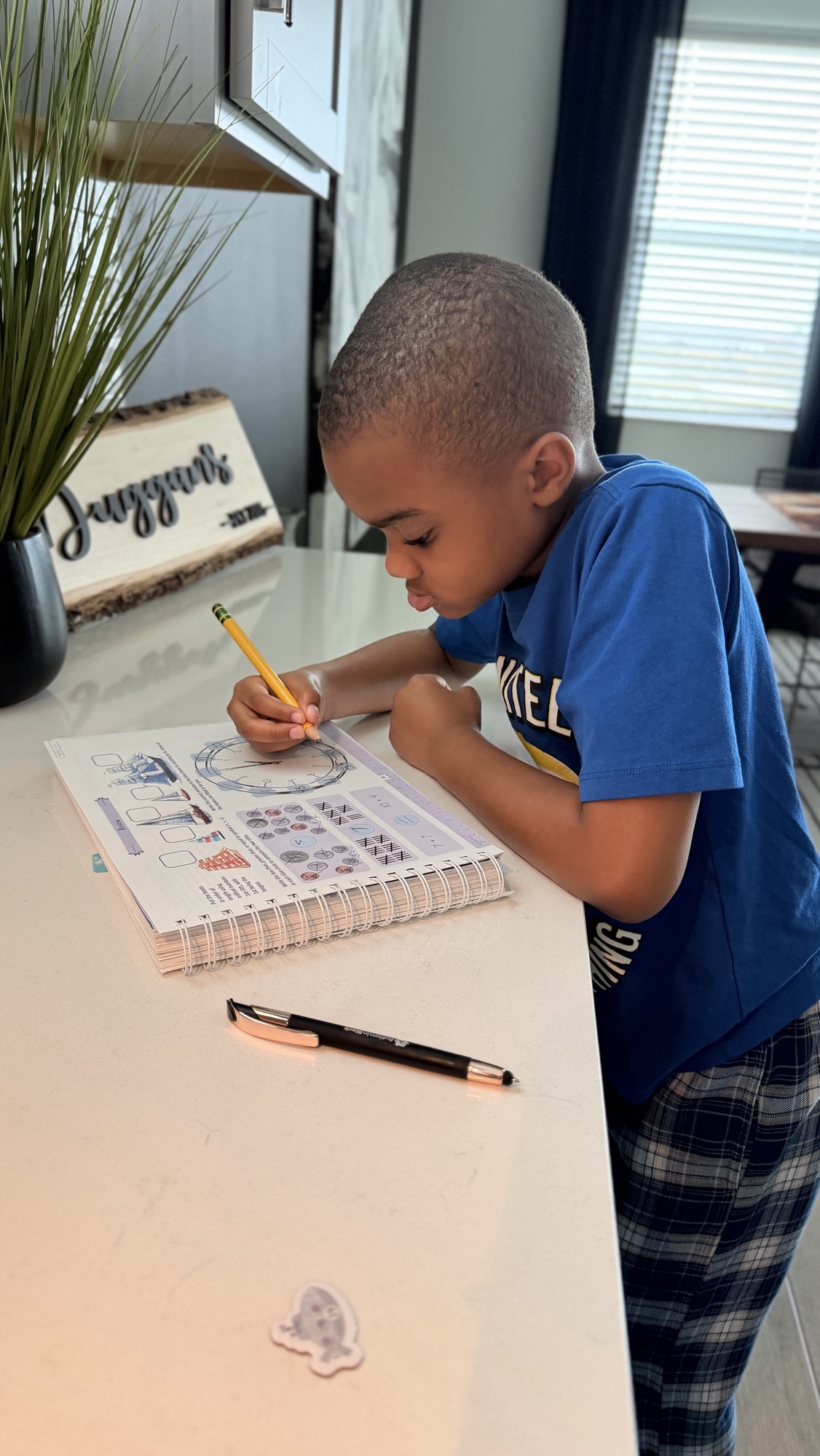
The picture above looks peaceful enough.
A little boy sitting at the kitchen table doing math.
What you don’t see is everything that happened before the photo was taken.
This was supposed to be the finish line.
After an entire year of Math 1, my son was completing his assessment. We had spent months learning and practicing. He could identify greater than and less than signs. He knew even and odd numbers. He could spell numbers, count by 5s, 10s, 25s, and 100s. He had worked hard and made incredible progress.
Then something unexpected happened.
It’s like his brain hit a wall.
Questions that should have been easy suddenly became difficult. Concepts he had demonstrated all year seemed to disappear. I sat there shocked, wondering how a child who had consistently done so well could suddenly struggle with material he clearly knew.
If I’m being truthful, I got frustrated.
Not because he wasn’t trying.
But because I knew what he was capable of.
At the same time, he was getting frustrated too. I could see it on his face. He wanted the answers. He wanted to get it right. He wanted to move on to Math 2.
But I wouldn’t give him hints.
Not because I wanted him to fail.
Because I wanted to know what he remembered without my help.
As homeschool parents, we often wear two hats. We’re the parent who wants to comfort our child and the teacher who needs accurate information about where they are academically.
Sometimes those two roles don’t get along very well.
As I watched him struggle, I had a realization.
I don’t remember everything all the time.
Neither do you.
Adults forget names, passwords, appointments, and things we’ve known for years. We have moments where our minds go blank. We get tired. We get overwhelmed.
Why do we expect children to be any different?
A little while later, I approached the problem differently.
I asked him a simple question:
“Who does Pac-Man eat?”
“The bigger one,” he answered.
And suddenly the connection came back.
The information hadn’t disappeared.
It was still there.
He just needed a different path to find it.
That moment changed my perspective.
His struggle wasn’t proof that he hadn’t learned.
It was proof that learning is messy.
It’s easy to celebrate our children when everything is clicking. It’s easy to post the perfect moments when they master a concept on the first try.
But real growth often happens in the moments nobody sees.
The moments when they get frustrated.
The moments when they want to quit.
The moments when they have to dig deep and try again.
When I told him we weren’t moving on to Math 2 until I was sure he truly understood Math 1, he was upset. Really upset.
But underneath that frustration was something that made me proud.
He cared.
He wanted to succeed.
He wanted to move forward.
That reaction told me more about his character than any assessment score ever could.
So over the next few days, we’re going to review.
We’ll revisit a few concepts.
We’ll rebuild confidence.
And then we’ll move on.
Because that’s another gift homeschooling has given our family.
We don’t have to rush.
We don’t have to move on because a calendar says it’s time.
We can slow down when needed and speed up when ready.
Learning isn’t a race.
It’s a journey.
And sometimes the lesson isn’t for the child.
Sometimes it’s for the parent sitting beside them.
This week, my son learned a little more math.
I learned a little more patience.
And honestly, that may have been the most important lesson of all.
Follow us on IG and TikTok @raisingmywiredking


